Most shoppers overlook label details, but you can learn to scan ingredients, nutrition facts and claims to protect your health: check serving size first, watch added sugars and sodium as potentially harmful, note allergens and preferrable high fiber or whole-grain ingredients, and treat marketing claims skeptically; use the FDA guide How to Understand and Use the Nutrition Facts Label to practice identifying real nutrition information and make informed choices.
Key Takeaways:
- Prioritize the ingredient list-ingredients are listed by weight so the first items show what the product mainly contains; watch for added sugars, hydrogenated oils, and common allergens.
- Use the Nutrition Facts panel to compare serving sizes, calories, macronutrients, sodium, and fiber per serving and per package to assess true portion impact.
- Evaluate marketing claims and seals by checking the ingredient list and Nutrition Facts; prefer products with whole-food ingredients, fewer additives, and clear labeling.
Understanding Grocery Labels
As you compare items on the shelf, focus on the ingredient order, Nutrition Facts panel, and allergen statements to decide quickly which product fits your goals. Ingredients tell you composition by weight, while the Nutrition Facts quantify calories, fats, and added sugars per serving. For instance, two tomato sauces can list similar calories but differ widely in sodium and added sugar, so scan both before you buy.
Ingredients List
Ingredients are listed by weight, so the first ingredient is the most abundant – if sugar appears first, the product is largely sugar. Watch for hidden sugars (dextrose, maltose, corn syrup), additives like partially hydrogenated oils (trans fats) or sodium nitrite, and allergen declarations; U.S. labels must now identify the top 9 allergens (milk, eggs, fish, shellfish, tree nuts, peanuts, wheat, soy, sesame).
Nutrition Facts
Nutrition Facts list serving size, calories, grams of fat/carbs/protein, and %DV to help you compare quickly: use 5% DV as low and 20% DV as high. The FDA daily values include added sugars 50 g and sodium 2,300 mg3 g fiber per serving and moderate saturated fat.
Pay attention to serving size and servings per container: if a package lists 250 calories per serving but contains two servings, eating the whole package gives 500 calories. Also note labeling rules allow “0 g trans fat” if under 0.5 g per serving, so check the ingredients for partially hydrogenated oils and use %DV to compare sodium, added sugar, fiber, and protein between similar products.
Decoding Nutrition Labels
Scan the Nutrition Facts for the big numbers: calories per serving, grams of total fat, saturated fat, trans fat, sodium, total carbs, fiber, sugars and protein, plus %DV. You should treat added sugars, trans fats, and sodium as red flags and value fiber and protein for satiety. The label summarizes what a single serving delivers, so use the numbers to compare similar products and spot hidden sources of salt, sugar, or unhealthy fat.
Serving Sizes
Check the serving size line first because manufacturers set it; a bag might list 1 oz (about 28 g or ~15 chips) per serving but contain 3 servings per bag, so eating the whole thing triples calories and nutrients. You should multiply calories, sodium and sugar by servings consumed, and use “per package” notation when available to avoid underestimating intake.
Daily Values
The %Daily Value (%DV) tells you how a nutrient fits into a standard 2,000-calorie diet: 5% DV or less is low, 20% DV or more is high. You should use %DV to judge nutrient density quickly-higher %DV for fiber, protein, vitamins is positive; higher %DV for added sugars, sodium, or saturated fat is negative.
For concrete benchmarks, the label’s DVs include about 2,300 mg sodium, 50 g added sugars, 78 g total fat, and 28 g fiber (on a 2,000-calorie basis). If a product shows 20% DV sodium, that equals ~460 mg; you should aim lower if you have hypertension (often advised <1,500 mg/day). Adjust these targets if your calorie needs differ.
Evaluating Health Claims
You’ll need to parse claims against the facts: terms like low fat, reduced, or high in fiber have specific thresholds and loopholes that affect nutrition. Manufacturers often reformulate to hit marketing tiers-sometimes adding sugar or sodium to lower fat-so check serving size and grams per serving. For example, the FDA allows “0g trans fat” if a serving contains less than 0.5 g, and that can add up across multiple servings.
Types of Claims
You can split claims into three practical groups: nutrient-content claims (e.g., “low fat,” “sugar-free”), health claims that reference disease risk (FDA-authorized), and structure/function claims that describe bodily effects without disease claims. Labels like “reduced” must show at least a 25% reduction versus a reference product, while “high” typically means ≥20% DV.
| Nutrient-content | “Low fat” ≤3 g per serving; “sugar-free” <0.5 g per serving. |
| Health claim | FDA-authorized statements linking a food/nutrient to reduced disease risk (e.g., soluble fiber and heart disease). |
| Structure/function | Claims like “supports immunity” that don’t mention disease and need substantiation but not FDA pre-approval. |
| Qualified claims | Weaker, conditional claims that include qualifying language when evidence is limited. |
| Front-of-package | Marketing shorthand (e.g., “made with whole grains”) that may reflect small ingredient amounts; always check ingredient list. |
- Low fat
- Reduced
- High
- This No added sugar can still include fruit concentrates or honey
Common Misleading Claims
You’ll see frequent tricks: “natural” is unregulated and doesn’t mean healthier, “made with real fruit” can mean 1% fruit puree, and “0g trans fat” may hide 0.4 g per serving-so multiple servings matter. Also, “light” can mean 50% fewer calories or less fat depending on context, so always check the Nutrition Facts and ingredient order.
Dig deeper by comparing products: a “low-fat” cookie might have 7 g added sugars vs. 2 g in a full-fat alternative, raising calories and metabolic impact. Use the ingredient list to spot added sugars (look for >1 name like sucrose, dextrose, maltodextrin), and verify claims against numeric thresholds-e.g., a “good source” denotes 10-19% DV of a nutrient while “high” is ≥20% DV. You should favor transparent labels and whole-food ingredients over clever marketing copy.
Tips for Making Informed Choices
When you scan labels in the aisle, prioritize clear signals: check serving size, note if sodium exceeds 400 mg per serving, and flag >4 g added sugars. You should favor short ingredient lists and products where whole ingredients appear first. Any time you compare two items, choose the one with less saturated fat, fewer added sugars, and more fiber.
- Serving size
- Ingredient list
- Added sugars
- Sodium
- Fiber
- Percent Daily Value (%DV)
Look for Whole Ingredients
You can quickly assess quality by scanning the first three ingredients: if they’re recognizable foods like oats, beans, or tomatoes, the product likely has fewer additives. Seek items without long chemical names – high-fructose corn syrup or partially hydrogenated oil signal added processing. Choosing whole-ingredient foods typically increases fiber and reduces hidden sugars and artificial additives.
Compare Nutritional Value
You should standardize comparisons to a common basis (per serving or per 100 g) when sizes differ. Favor lower sodium and saturated fat, higher fiber and protein. For example, a cereal with 6 g fiber versus 1 g markedly improves satiety and glycemic response; use %DV to gauge impact.
To compare effectively, convert labels to the same unit, check %DV where 5% is low and 20% is high, and weigh functional nutrients: aim for ≥3 g fiber per serving, ≤140 mg sodium for a “low” claim, and minimal added sugars relative to daily limits (≤25-36 g/day).
Quick comparison guide
| What to check | Why it matters / Target |
|---|---|
| Serving size | Standardize per 100 g or per serving so calories and nutrients are comparable |
| % Daily Value (%DV) | Use %DV: 5% = low, 20%+ = high |
| Fiber | Aim for ≥3 g per serving to support fullness and digestion |
| Sodium | ≤140 mg per serving is considered low; watch for >400 mg |
| Added sugars | Prefer minimal grams; compare against AHA limits (~25-36 g/day) |
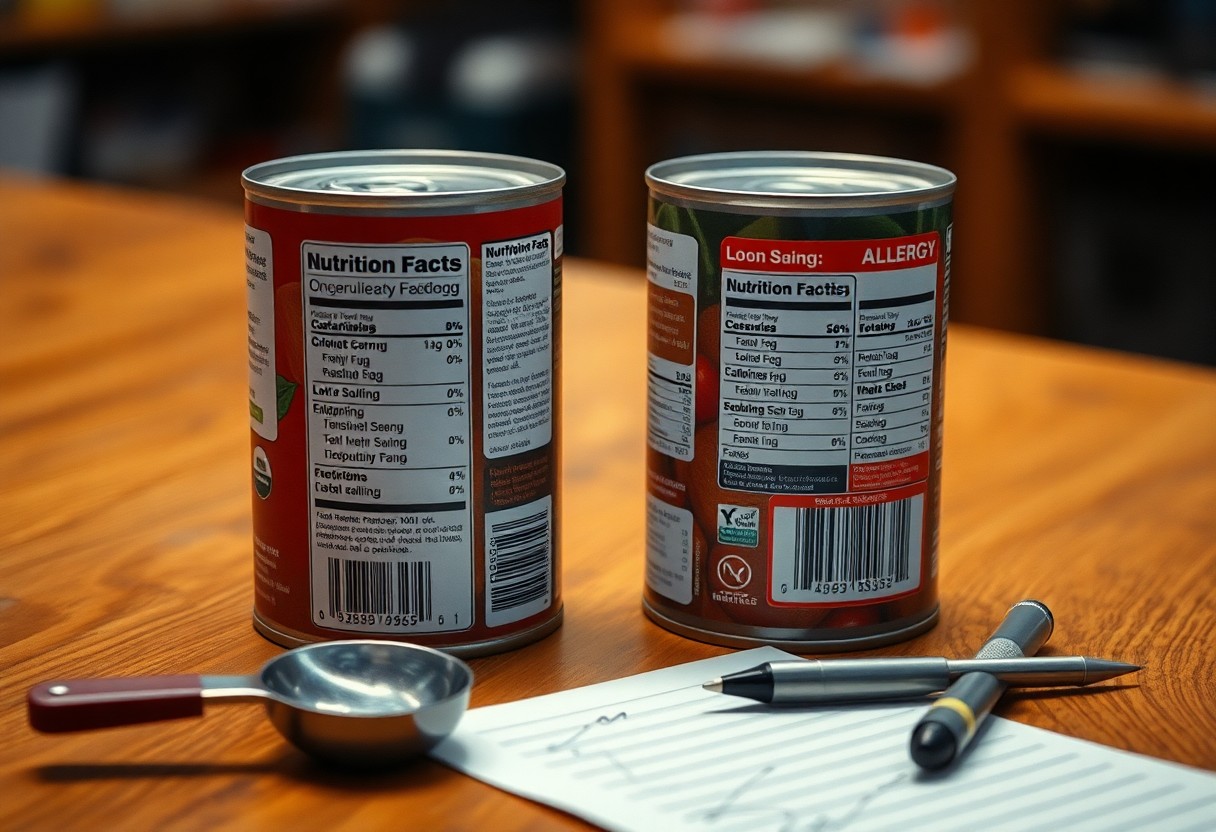
Factors to Consider When Shopping
When you compare items, focus on serving size, ingredient order, and amounts of added sugars and sodium; high sodium (e.g., >400 mg/serving) and any trans fat are dangerous, while whole grains and ≥3 g fiber per serving are positive signals. Consult official Food labels for guidance. Perceiving how these elements affect your daily totals will help you choose smarter.
- Serving size
- Ingredients
- Sodium
- Added sugars
- Trans fat
- Fiber & whole grains
Personal Dietary Needs
Tailor choices to your goals: if you limit sodium, keep total daily sodium below 2,300 mg and prefer products with <400 mg per serving; for weight control compare calories per serving and favor items with 20-30 g protein or ≥3 g fiber per serving. If you follow plant-based, ketogenic, or low-FODMAP plans, scan the ingredient list for hidden animal, high-carb, or fermentable ingredients and use % Daily Value to gauge whether a nutrient is high or low for your needs.
Allergens and Sensitivities
Scan labels for the ‘Contains’ statement and the top allergens-peanuts, tree nuts, milk, egg, soy, wheat, fish, shellfish-and heed advisory phrases like ‘may contain’ or ‘made in a facility’ that signal cross-contact risk; if you have a severe allergy, avoid products without clear allergen disclosure and contact the manufacturer when in doubt.
When managing allergies, note advisory phrasing isn’t standardized-‘may contain’ versus ‘made on shared equipment’ doesn’t measure risk, so if your reaction can cause anaphylaxis you should avoid uncertain products. Watch for hidden sources listed as natural flavors, hydrolyzed proteins or enzyme preparations that may include milk, soy or wheat derivatives. For celiac disease, choose items with a certified gluten-free label (<20 ppm) or request testing data, and keep prescribed emergency medication accessible.
How to Efficiently Read Labels
When you scan a package, first check the serving size, then calories and % Daily Value; if a snack lists “2 cookies” and you eat 4, double everything. Use tools like Understanding Food Labels – The Nutrition Source for deeper guidance on interpreting %DV and ingredient order.
Start with Ingredients
Read the ingredients list top to bottom because items are listed by weight; if sugar, high-fructose corn syrup or partially hydrogenated oils appear near the top, the product is likely high in added sugars or trans fats. You should favor items where whole grains or single-ingredient foods (e.g., oats, chicken) are first.
Focus on Key Nutritional Information
Pay attention to serving size, calories, saturated fat, sodium, added sugars, and fiber. For context, general guides use ~2,300 mg sodium/day and <10% of calories from added sugars (~50 g on a 2,000 kcal diet), so judge a single serving against those benchmarks.
Use % Daily Value to prioritize: <= 5% DV is low, >= 20% DV is high. For example, 20% DV sodium equals ~460 mg (20% of 2,300 mg). If a product shows 30% DV added sugars, combine that with ingredient order to decide if it’s an occasional treat or a frequent choice.
To wrap up
With these considerations, you can confidently evaluate ingredients lists, compare nutrition facts, and interpret marketing claims to align purchases with your health goals. Check serving sizes, prioritize whole foods, monitor added sugars and sodium, and focus on standardized label information rather than front-of-package buzzwords to make smarter choices at the store.
FAQ
Q: How do I read the ingredients list to spot added sugars, allergens, and highly processed ingredients?
A: Ingredients are listed in descending order by weight – the first few items dominate the product. Scan those top ingredients for sources of added sugar (sucrose, glucose, high-fructose corn syrup, maltose, dextrose, syrup, cane sugar, fruit juice concentrate), refined grains (enriched flour vs. whole grain), and added fats (partially hydrogenated oils indicate trans fats). Allergens are often highlighted or appear in a “Contains:” statement; if you have allergies, read the entire list for milk, eggs, wheat, soy, peanuts, tree nuts, fish, and shellfish and for cross-contact warnings. Watch for ingredient-adjacent terms like “hydrolyzed,” “isolate,” “concentrate,” or long chemical names – these often indicate more processing. If the same sweetener appears multiple times under different names, that usually means added sugar is higher than it looks at first glance.
Q: What should I check on the Nutrition Facts panel to compare products accurately?
A: Start with serving size and servings per container – calories and nutrients are listed per serving, so a smaller serving can understate the impact of the whole package. Compare calories, total fat (and saturated/trans fat), total carbohydrate (with fiber, total sugars, and added sugars listed separately), protein, and sodium per realistic portion. Use % Daily Value (%DV) to gauge nutrient significance: 5% DV or less is low, 20% DV or more is high for most nutrients, based on a 2,000-calorie diet. For direct product comparisons, convert to per-100 g or per-entire-package values if servings differ. Give extra weight to fiber, protein, and low sodium when seeking more filling, lower-sodium choices; limit products high in added sugars, saturated fat, and sodium.
Q: How trustworthy are front-of-package claims like “organic,” “natural,” “low-fat,” and “non-GMO,” and how should I interpret them?
A: Front claims can be helpful but are often simplified or regulated differently depending on the claim. “USDA Organic” (or your country’s organic seal) is certified and indicates production standards; “made with organic” or “organic ingredients” describes partial use of organic components. “Natural” is loosely defined in many jurisdictions and may not guarantee minimal processing. “Low-fat” generally means 3 g of fat or less per serving (U.S. standard); “reduced” or “light” have specific criteria (for example, at least 25% fewer calories or 50% less of a nutrient compared to a reference). “No added sugar” means no sugars were added but the product can still contain intrinsic sugars and may be high in calories; “sugar-free” typically means less than 0.5 g sugar per serving. “Non-GMO” is usually a voluntary label indicating ingredients were not derived from genetically modified organisms but does not imply health or safety benefits. Fortified or enriched foods have nutrients added back; check the ingredient list and Nutrition Facts to see which nutrients and amounts. Always verify claims against the Nutrition Facts and ingredients list rather than relying solely on front labels.